General Grant
Around the World in Eighty DaysThe General Grant is the vessel that carries Phileas Fogg, Aouda, and Passepartout from Yokohama to San Francisco, turning a transpacific crossing into both a test of the journey’s timetable and a stage for renewed conflict with Fix. A large, fast paddle-wheel steamer, it gives Fogg reason to expect that he can reach London before the wager’s deadline; aboard it, the distance already covered is measured against the miles and days still ahead.## Vessel and Crossing Owned by the Pacific Mail Steamship Company, the General Grant is described as a 2,500-ton paddle-wheel steamer, well equipped and very fast. Its machinery is presented with unusual precision: a massive walking-beam rises and falls above the deck, a piston-rod moves at one end, and a connecting-rod at the other converts the motion into rotation at the paddle shaft. Three masts provide ample sail capacity, supplementing the steam power. The vessel’s design makes its speed a practical feature of the plot rather than a decorative claim: at twelve miles an hour, it is expected to cross the Pacific in twenty-one days.
The crossing begins with a full complement of passengers: English travelers, many Americans, numerous coolies bound for California, and several East Indian officers taking a world tour during their leave. The voyage itself is uneventful. The steamer’s large paddles keep it steady enough to roll little, and the Pacific seems to merit its name. Against this calm, Fogg remains as taciturn as before; the ship affords him no pause from calculating the next stage of his journey, but it does offer a comparatively direct passage after the long circuits across Asia.
Fogg’s Timetable and the Midpoint
The General Grant’s projected pace supports Fogg’s schedule. He hopes to reach San Francisco by December 2, New York by December 11, and London on December 20, several hours ahead of the fatal date of December 21. These are expectations, not guarantees, but the ship’s speed gives them a credible basis. The ocean crossing is therefore one link in a carefully calculated chain: a railway journey across the United States and a transatlantic steamer from New York to Liverpool must follow it.
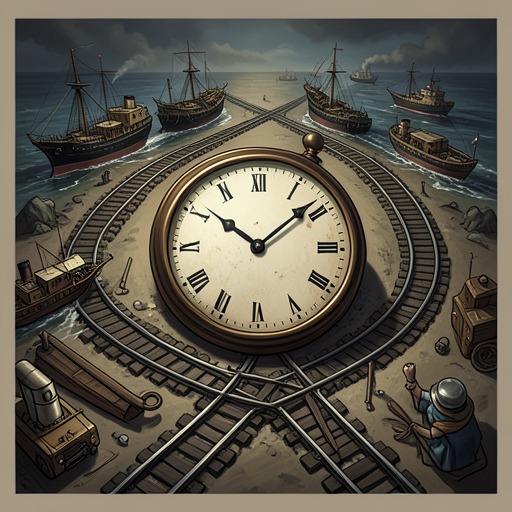
On November 23, the ninth day after leaving Yokohama, the General Grant passes the 180th meridian, placing the travelers at the antipodes of London. In longitude, Fogg has crossed exactly half the globe. In practical distance, however, the halfway point is misleading: fifty-two of the eighty days have been used, with only twenty-eight remaining, yet he has completed two-thirds of the actual route. Earlier journeys from London to Aden, Aden to Bombay, Calcutta to Singapore, and Singapore to Yokohama forced long detours. The total route will be about 26,000 miles rather than the roughly 12,000 miles that a direct course along London’s fiftieth parallel would require; Fogg has already covered 17,500 miles. With the remaining course described as straight and Fix apparently no longer obstructing them, the ship’s progress encourages confidence even as the shrinking reserve of days keeps the deadline present.
Aboard: Aouda, Passepartout, and Fix
The crossing also makes visible Aouda’s growing attachment to Fogg. His silent generosity impresses her, and she becomes increasingly interested in his plans and impatient with anything that might delay the journey. She talks often with Passepartout, who recognizes her feelings and praises Fogg’s honesty, generosity, and devotion. He tries to reassure her that the hardest part is past and that the railway from San Francisco to New York, followed by the steamer to Liverpool, should bring them home in time. His confidence is hopeful, but it rests on the same route and timetable that Fogg is pursuing.
Fix is on board too, though Passepartout does not know it at first. After reaching Yokohama, Fix went to the English consulate and finally obtained the arrest warrant that had followed him from Bombay on the Carnatic. By then Fogg had left English territory, so the warrant could not simply be used there; Fix concluded that he would have to follow him across the Atlantic and act in England. Expecting to encounter Fogg again, he boarded the General Grant and arrived before Fogg and Aouda. He recognized Passepartout despite the theatrical disguise, hid in his cabin to avoid an explanation, and hoped the crowd of passengers would keep him unnoticed.
That concealment fails when Fix and Passepartout meet face to face on the forward deck. Passepartout rushes at the detective, seizes him by the throat, and strikes him repeatedly, while a group of amused Americans bet on the fight. The encounter converts the ship from a quiet corridor of travel into a confined space of unresolved antagonism. Later, Passepartout accepts Fix as a possible ally but warns that any treachery will bring another attack; Fix agrees. The alliance is wary and conditional, shaped by Passepartout’s anger and by the practical need to continue the journey.
Arrival and Narrative Function
Eleven days later, on December 3, the General Grant enters the bay of the Golden Gate and reaches San Francisco. Fogg has neither gained nor lost a day. That precise result closes the ocean leg without providing a margin over his original schedule: the crossing has kept the timetable intact, but has not put him ahead of it. The travelers can now proceed toward the railway route across the United States, while the projected arrival in New York and the onward passage to Liverpool remain necessary steps rather than accomplished facts.
The General Grant thus serves several functions at once. Its engineering and stated speed establish why Fogg can reasonably expect the Pacific crossing to fit his plan; its steady, uneventful passage contrasts with the detours and confrontations that have marked earlier stages; and its passenger-filled decks bring Fix back within reach of Passepartout. The crossing also distinguishes apparent progress from measurable progress: the travelers are at the opposite meridian from London, but their route is only two-thirds complete by distance, and the calendar has consumed most of the allotted time. The ship brings the party to the American continent on schedule, carrying both the promise of onward speed and the tensions that will travel with them.